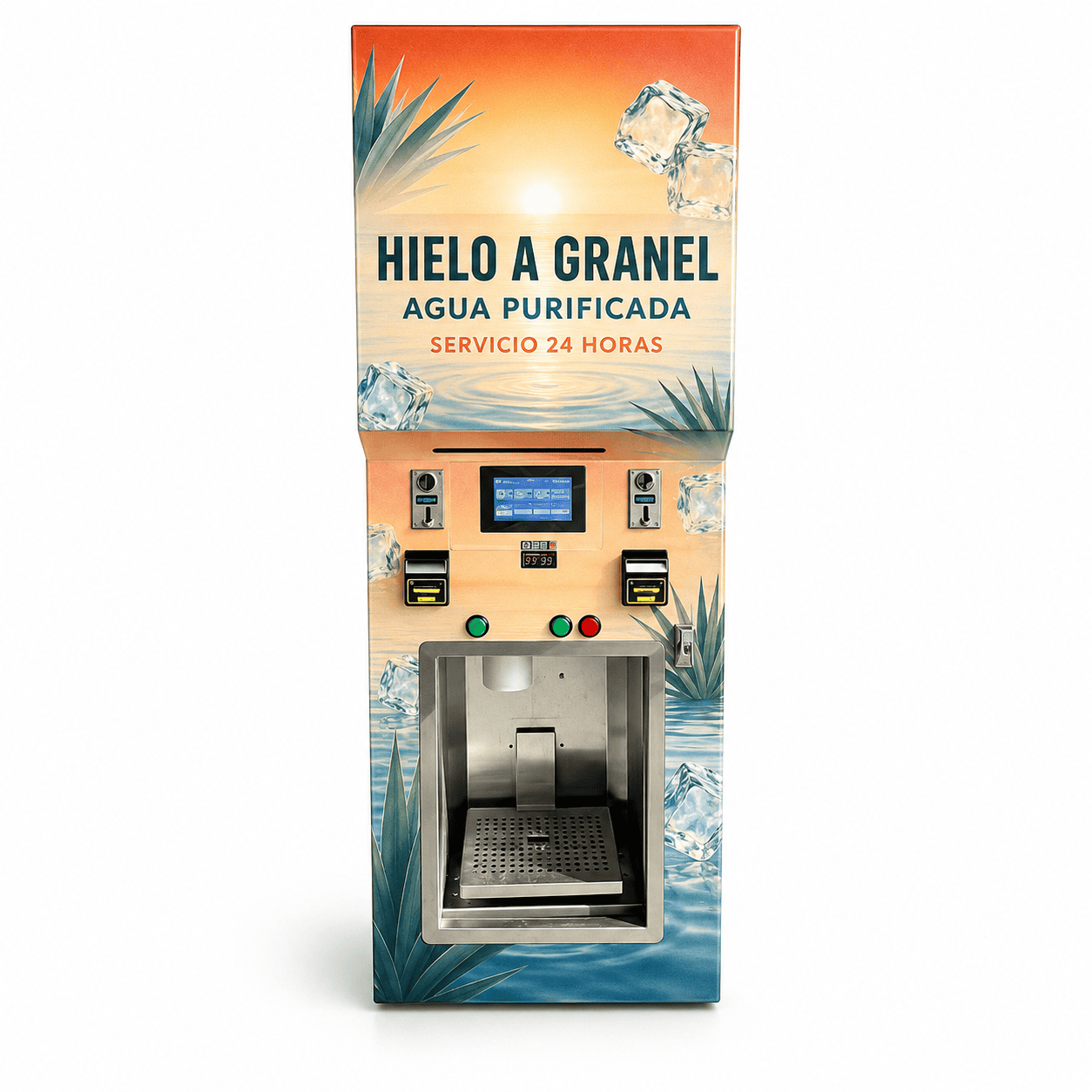



Ice vending machines provide customers with a convenient way to purchase fresh ice 24 hours a day. They are widely used near supermarkets, convenience stores, beaches, campsites, hotels, seafood markets, gas stations and residential communities.
Unlike a traditional ice shop, an automatic ice vending machine can make, store and dispense ice without requiring an employee to remain on-site. Customers simply select the amount of ice they need, complete the payment and collect the ice.
But how does an ice vending machine actually work? In this guide, YISO explains the complete process, from water filtration and ice production to payment and automatic dispensing.
What Is an Ice Vending Machine?
An ice vending machine is an automated retail machine that produces and sells ice directly to customers.
The machine normally combines several systems:
- Water filtration system
- Commercial ice-making system
- Insulated ice storage bin
- Automatic ice dispensing system
- Payment system
- Touchscreen or control panel
- Remote monitoring system
- Optional automatic bagging system
All these systems work together to provide continuous, unattended ice sales.
Depending on the configuration, customers may purchase bulk ice directly into their own container or receive automatically packaged bags of ice.
Step 1: Water Enters the Filtration System
The ice-making process begins when water enters the machine through the connected water supply.
Before the water reaches the ice-making system, it passes through a filtration system. The filter configuration can be customized according to the local water quality and the buyer’s requirements.
A suitable filtration system helps:
- Reduce sediment and visible impurities
- Improve the taste and appearance of the ice
- Protect the internal ice-making components
- Reduce mineral buildup
- Improve the operating life of the machine
For areas with poor water quality, additional filtration or water-treatment equipment may be required.
Step 2: The Machine Automatically Produces Ice
After filtration, the water enters the commercial ice-making system.
The refrigeration system lowers the temperature and automatically produces ice. Depending on the machine model, the equipment can produce different types and quantities of ice.
Sensors inside the machine monitor the ice-making process. When the ice storage bin reaches the preset level, the machine can temporarily stop producing ice. When the amount of stored ice decreases, the system automatically starts producing ice again.
This automatic control helps reduce unnecessary energy consumption and allows the machine to maintain a stable ice supply.
Step 3: Ice Is Stored Inside the Machine
After production, the ice falls into an insulated storage bin.
The storage bin is designed to keep the ice in suitable condition before it is sold. Its capacity should be selected according to the expected daily sales volume, local temperature and peak purchasing times.
In hot climates or high-traffic locations, buyers should choose a machine with sufficient ice-making and storage capacity. This helps prevent the machine from running out of ice during busy periods.
Some machines can also include an ice-agitation or anti-blocking system to improve dispensing performance.
Step 4: The Customer Selects the Required Amount
Customers use the machine’s screen or control panel to select how much ice they want to purchase.
Available quantities can be customized, such as:
- 1 kg
- 2 kg
- 5 kg
- 10 kg
The language, product options, prices and screen interface can also be customized for different countries and markets.
Clear operating instructions make the purchasing process simple, even for customers using the machine for the first time.
Step 5: The Customer Completes the Payment
After selecting the required amount, the customer chooses a payment method.
Depending on the destination country and machine configuration, an ice vending machine can support:
- Coins
- Banknotes
- Credit or debit cards
- QR-code payments
- Barcode payment systems
- Prepaid cards
- Customized local payment systems
Because payment habits vary between countries, buyers should confirm the most suitable payment method before production.
YISO can reserve installation space and communication interfaces for compatible payment devices according to the project requirements.
Step 6: The Machine Automatically Dispenses Ice
After the payment is confirmed, the control system sends an instruction to the ice dispensing mechanism.
The machine measures the selected amount of ice and releases it through the ice outlet. Customers can collect the ice using their own container or bag.
The complete process normally includes:
- Selecting the required amount
- Completing the payment
- Confirming the order
- Automatically dispensing the ice
- Completing the transaction
The process is fast and does not require an on-site employee.
Bulk Ice and Automatically Bagged Ice
There are two common ice-selling methods.
Bulk Ice Vending
With bulk ice vending, customers place their own bag, bucket or container under the ice outlet. The machine then dispenses the selected amount directly.
This configuration usually has a simpler structure and is suitable for markets where customers are accustomed to bringing their own containers.
Automatic Ice Bagging
An automatic bagging ice vending machine can automatically prepare, fill and dispense bags of ice.
This option can provide a more standardized retail experience and may be suitable for supermarkets, convenience stores, tourist attractions and other commercial locations.
However, an automatic bagging system has more mechanical components, so buyers should pay greater attention to maintenance, bag specifications and the reliability of the packaging system.
Can the Machine Be Monitored Remotely?
An ice vending machine can be equipped with a remote management system.
Depending on the selected system, the operator may be able to check:
- Sales records
- Payment information
- Machine operating status
- Ice availability
- Fault notifications
- Equipment temperature
- Maintenance information
Remote monitoring is especially useful when one operator manages several machines in different locations.
It reduces the need for frequent on-site inspections and helps the operator respond more quickly when the machine requires attention.
What Is Required to Install an Ice Vending Machine?
Before installation, the buyer should confirm the following conditions:
Water Supply
The machine requires a stable water source. The incoming water quality and pressure should meet the equipment requirements.
Electrical Supply
Voltage and frequency vary by country. The correct electrical configuration should be confirmed before production.
Drainage
A suitable drainage connection is required for wastewater and cleaning.
Installation Space
The site should provide sufficient space for installation, ventilation, maintenance and customer operation.
Internet or Mobile Connection
If the machine uses remote monitoring, cashless payment or a barcode payment system, a stable network connection may be required.
Outdoor Protection
For outdoor installation, the machine should be protected against rain, strong sunlight, high temperatures and other environmental conditions. A canopy or suitable outdoor structure may be recommended.
How to Choose the Right Ice Vending Machine
Before purchasing a machine, buyers should consider several important factors.
Daily Ice Production
Estimate the expected daily sales volume and select an ice-making capacity that can meet demand during peak periods.
Storage Capacity
The storage bin should hold enough ice for busy sales periods without taking up unnecessary space.
Local Climate
Machines installed in hot or humid areas may require different cooling and ventilation configurations.
Payment Methods
Choose payment systems that match local customer habits and banking conditions.
Ice Dispensing Method
Decide whether customers will purchase bulk ice or automatically packaged ice.
Machine Location
Consider pedestrian traffic, vehicle access, water supply, electricity, drainage and security.
Technical Support
Choose a supplier that can provide manuals, installation videos, spare parts and remote technical assistance.
Why Choose YISO?
YISO is a vending machine manufacturer in China with experience in unmanned self-service equipment.
We provide ice vending machines, water vending machines, laundry detergent vending machines and other customized vending solutions.
Our services include:
- OEM and ODM customization
- Customized machine appearance and logo
- Multiple language options
- Customized payment systems
- Voltage and plug customization
- Remote management solutions
- CE and RoHS-supported solutions
- English manuals and installation videos
- Remote technical support
- Export packaging and shipping assistance
We can recommend a suitable machine configuration according to the customer’s country, climate, payment habits, installation site and business requirements.
Conclusion
An ice vending machine combines water filtration, automatic ice production, insulated storage, payment processing and automatic dispensing in one self-service system.
When the machine is correctly configured and installed in a suitable location, it can provide convenient 24-hour ice sales with reduced labor requirements.
Before purchasing, buyers should carefully evaluate daily production capacity, storage capacity, payment methods, installation conditions and after-sales support.
Looking for an automatic ice vending machine for your market?
Contact YISO to receive machine specifications, customization options and a quotation for your project.